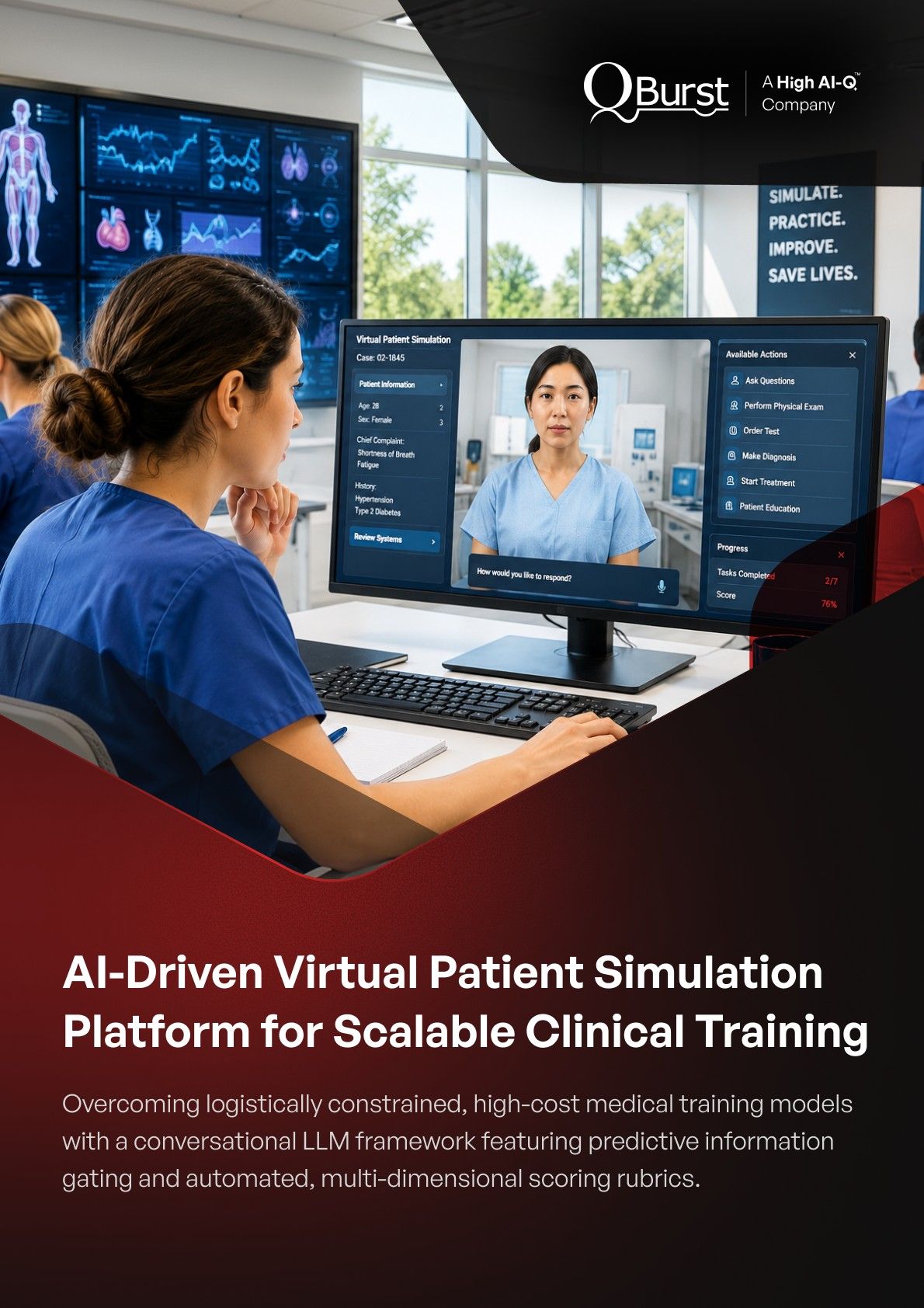
Overcoming logistically constrained, high-cost medical training models with a conversational LLM framework featuring predictive information gating and automated, multi-dimensional scoring rubrics.
A leading integrated academic health system and medical education provider in the United States, managing a large-scale network of inpatient facilities, outpatient clinics, and elite research institutions supported by over 40,000 healthcare professionals.
The client’s medical training programs faced severe financial and logistical bottlenecks when scaling hands-on diagnostic training. Traditional methodologies—such as standardized patient actors, physical mannequins, and static casebooks—are expensive, difficult to coordinate, and restrict students' exposure to diverse, multi-variable clinical presentations prior to practical rotation.
We engineered a full-stack, conversational Large Language Model (LLM) simulation platform where medical students conduct unscripted clinical interviews with AI-driven patient personas.
This prominent US academic health system sits at the intersection of clinical excellence, medical research, and workforce education. By training thousands of future doctors, nurses, and specialists annually, the organization relies on tech-driven innovation to deliver continuous, on-demand clinical exposure while maintaining strict pedagogical safety and objective evaluation metrics.
Traditional electronic training systems lacked the contextual depth to mirror realistic clinical consultation environments:
We constructed a production-grade monorepo web ecosystem pairing a highly responsive React frontend with a robust Node.js/Express REST API, a MySQL 8 database layer, and deep OpenAI API workflows.
The platform transforms clinical curriculum delivery through five technical components:
Dynamic Patient Persona Simulation
When a user begins an interview session, the backend architecture contextually weaves a three-layer prompt framework combining static fallbacks, database-driven Handlebars templates, and case-specific instructions. Sent directly to advanced LLMs (gpt-4o/gpt-4o-mini), the system generates dynamic, contextually accurate patient behavior, matching customized difficulty tiers defined by faculty.
Pre-Prompt Information Gating
To enforce strict diagnostic discovery paths (History—Examination—Investigations), we introduced a data mutation filter that runs directly before prompt compilation. If a student tries to bypass steps to request advanced imaging, the application replaces the locked diagnostic value with an administrative placeholder before the prompt touches the AI model, completely blocking accidental data leakage.
Disclosure Tracking & Grading Guardrails
To ensure objective, unbiased evaluation, we implemented an asynchronous per-message classification layer. This module analyzes real-time conversation to identify what information was formally requested versus what was naturally volunteered by the patient persona, storing the resulting JSON log inside the active session. This history log passes directly into the final evaluation prompt, protecting the student from scoring penalties during final rubrics processing.
Code-Free Case Authoring Engine
Faculty members can independently build and publish entire clinical records using a modular workspace editor. Every structured data panel—covering demographics, physical presentation, vitals, labs, and scoring weight configurations—is equipped with an inline AI generation wizard to instantly generate clinically plausible baseline values.
Client Profile
Challenges
QBurst Solution
Technical Highlights
Impact