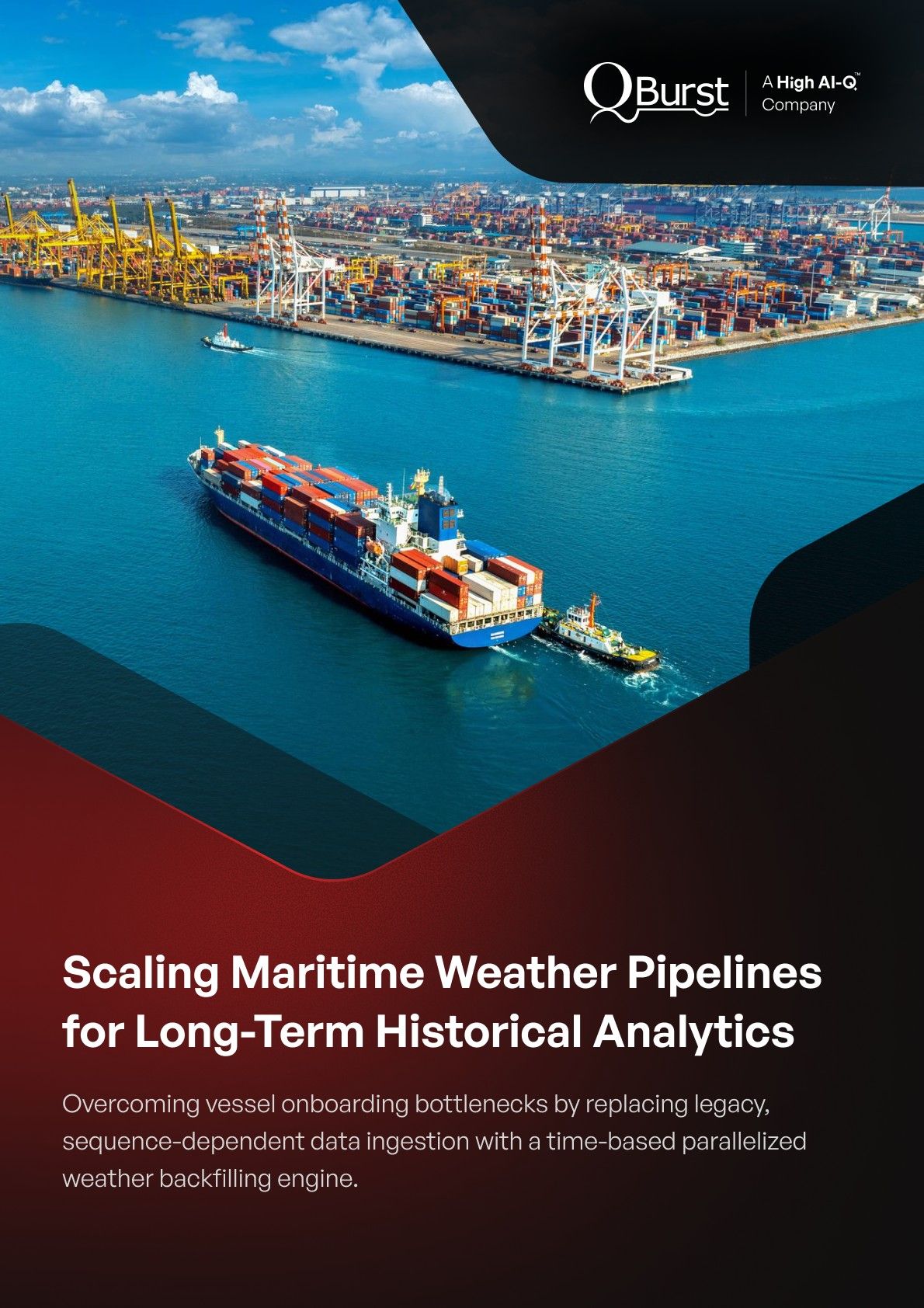
Overcoming vessel onboarding bottlenecks by replacing legacy, sequence-dependent data ingestion with a time-based parallelized weather backfilling engine.
A leading global provider of digital transformation solutions and ERP systems for the maritime industry.
The client’s existing weather data API was throttled by a hard 180-day limitation on historical weather (hindcast) retrieval, which caused massive operational delays during large-scale vessel onboarding and crippled long-term analytics.
We re-architected a legacy maritime weather data ingestion platform to support historical backfilling for up to 5 years, with built-in architectural extensibility.
This maritime industry leader turns traditional shipping systems into smart, connected enterprises. By leveraging IoT and AI, they provide global operators with the tools to optimize predictability, reduce costs, and achieve aggressive environmental sustainability goals.
The client’s weather pipeline suffered from linear processing dependency, causing systemic strain as their market share expanded:
QBurst completely overhauled the data engineering topology. Rather than treating each vessel as a separate data thread, we built a highly parallelized ingestion pipeline that divides historical requests into distinct time windows.
The architectural transformation focused on decoupled scale:
Client Profile
Challenges
QBurst Solution
Key Features
Impact